
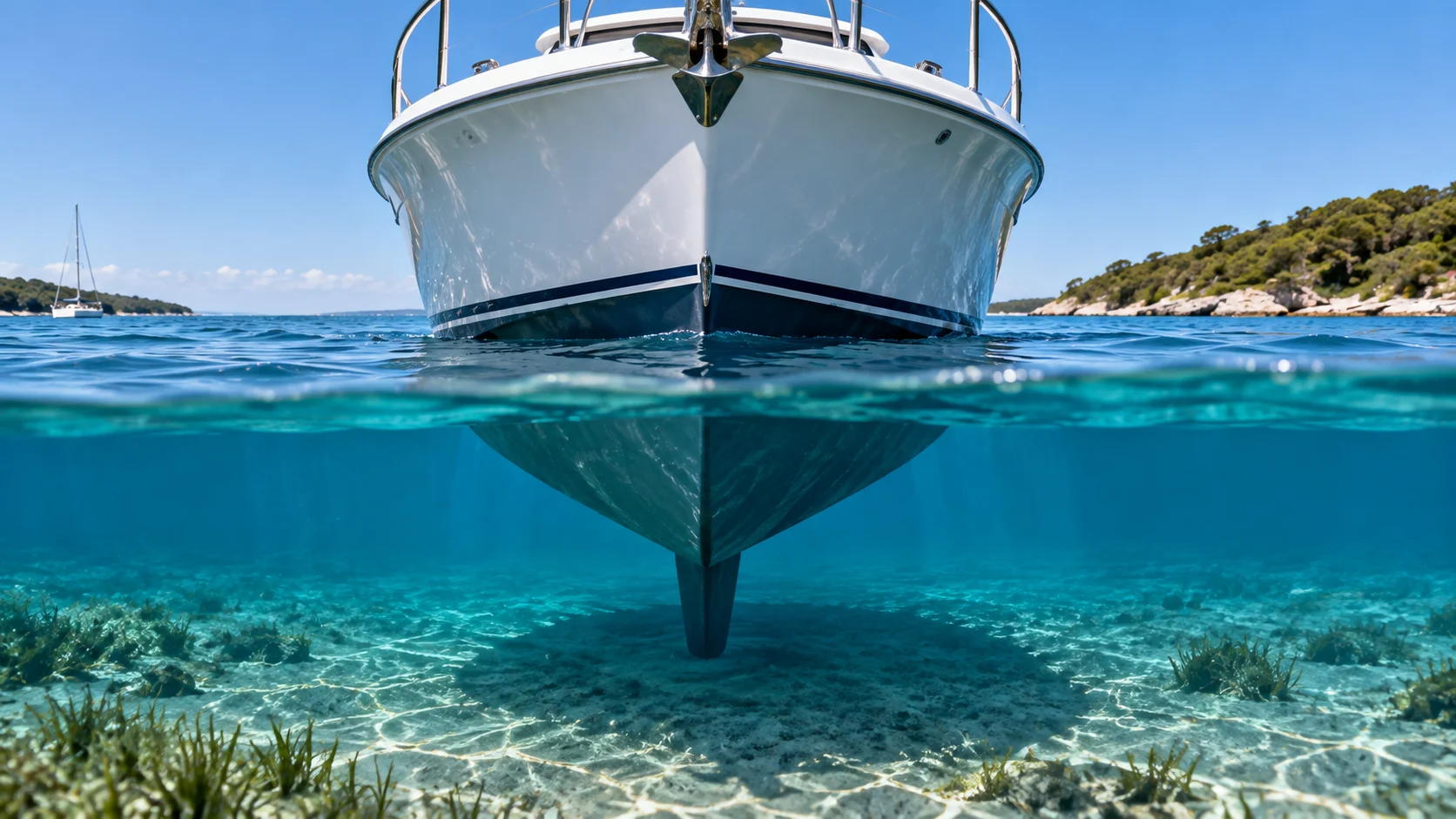
If you are buying a boat, checking a marina, planning a trip, or simply learning how boats work, boat draft is a measurement you will come across often. It tells you how far the lowest part of a boat sits below the waterline.
Draft matters because it affects where a boat can safely operate. A boat with a shallow draft can usually enter areas with less water, while a deeper boat needs more clearance. Knowing the draft can help you avoid running aground, choose suitable waterways, and understand how much water your boat needs.
This guide explains what boat draft means, how it is measured, why it changes, and how to determine the right amount of water under your boat.
Key Takeaways
- Boat draft tells you how much water a boat needs below the waterline to avoid touching the bottom.
- The actual draft of a boat can change with passengers, fuel, freshwater, equipment, and other added weight.
- Draft is especially important when navigating shallow channels, bays, rivers, lakes, and areas affected by tides.
- The lowest point of a boat may not always be the hull, so underwater equipment such as the propeller, rudder, or lower unit should also be considered.
- Checking draft before buying a boat can help you choose a vessel that suits your usual fishing, cruising, and docking locations.
What Is Boat Draft?
Boat draft is the vertical distance between the waterline and the lowest point of the boat below the water.
In simple terms, it answers one basic question:
How deep does the boat sit in the water?
For example, if a boat has a draft of 3 feet, its lowest point extends approximately 3 feet below the waterline.
The lowest point depends on the design of the boat. It may be the bottom of the hull, a keel, a propeller, a rudder, a skeg, or another underwater component.
Draft is normally given in feet and inches, although it can also be measured in meters.
Why Does Boat Draft Matter?
Draft is important because water depth is not the same everywhere.
A channel may have plenty of water in one section and become considerably shallower farther along. Tides can also change the available depth in coastal areas.
If a boat requires 4 feet of water but enters an area that is only 3 feet deep, the bottom of the boat may hit the seabed.
That can damage the hull or underwater equipment and may leave the boat stuck until the water level changes.
Draft is therefore an important number to know before navigating unfamiliar waters.
It can also affect where you can keep your boat. Some marinas, docks, canals, and boat ramps have depth limitations.
How Is Boat Draft Measured?
Draft is measured vertically from the waterline down to the lowest point of the boat.
The measurement is normally taken when the boat is floating in a specified condition, because the draft can change depending on how much weight the boat is carrying.
A manufacturer’s specifications may list a particular draft based on a standard loading condition.
In practice, the actual draft can be different.
Fuel, water, passengers, fishing equipment, coolers, batteries, and other gear all add weight. As the boat becomes heavier, it can sit lower in the water and its draft can increase.
This is why the published draft should be treated as an important reference rather than a guarantee that the boat will always sit at exactly that depth.
What Is the Difference Between Draft and Depth?
Boat draft and water depth describe two different things.
Draft describes the boat.
Water depth describes the water.
If your boat has a draft of 3 feet, it needs more than 3 feet of water to avoid touching the bottom. If the water is 10 feet deep, there is approximately 7 feet of water beneath the lowest point of the boat, assuming the draft measurement applies to the current loading condition.
The difference between the water depth and the boat’s draft is often called under-keel clearance.
For safe navigation, you should not assume that having exactly the same amount of water as the boat’s listed draft is sufficient.
What Is Under-Keel Clearance?
Under-keel clearance is the amount of water between the lowest part of the boat and the bottom.
For example, if the water is 8 feet deep and the boat’s draft is 3 feet, the theoretical clearance is 5 feet.
However, real-world conditions can reduce that clearance.
Water levels can change. Waves can cause the boat to move vertically. A loaded boat may sit lower than expected. Charts may also contain depth information that does not perfectly represent current conditions.
For these reasons, boaters generally allow an additional safety margin instead of navigating with only a few inches of clearance.
What Is a Shallow-Draft Boat?
A shallow-draft boat is designed to operate in relatively shallow water.
These boats are useful in areas such as shallow bays, flats, rivers, lakes, marshes, and coastal waterways where a deeper boat may have difficulty navigating.
Common examples include many flats boats, jon boats, skiffs, and certain pontoon boats.
The main advantage is access.
A shallow-draft boat can reach areas that may be inaccessible to vessels with deep keels or other underwater components.
However, shallow draft does not mean the boat can safely operate in any extremely shallow area. The propeller, lower unit, rudder, or other equipment may extend below the hull.
What Is a Deep-Draft Boat?
A deep-draft boat extends farther below the waterline.
Sailboats with deep keels are a common example. Large cruising boats and other vessels may also have significant draft.
A deeper draft can provide advantages in certain designs. For sailboats, a deeper keel can contribute to stability and help resist sideways movement caused by wind.
The trade-off is reduced access to shallow water.
A deep-draft vessel may need deeper channels, docks, and anchorages.
Does Boat Type Affect Draft?
Yes. Boat design has a major influence on draft.
Different boats are designed around different priorities.
A small fishing boat may have a shallow hull that allows it to operate close to shore. A sailboat may have a deep keel designed to improve stability and sailing performance.
A cabin cruiser may have a deeper hull and underwater running gear than a small center-console boat.
The engine configuration also matters. An outboard-powered boat may have a different minimum operating depth from an inboard-powered boat because the propeller and lower unit are positioned differently.
Does Weight Change Boat Draft?
Yes.
Adding weight generally causes a floating boat to sit lower in the water.
Imagine a boat with a few passengers and little equipment onboard. It may sit relatively high in the water.
Now add several passengers, full fuel tanks, full freshwater tanks, fishing gear, coolers, batteries, and other supplies. The additional weight causes the hull to displace more water, which increases the boat’s draft.
This is one reason boaters should consider their actual loading conditions when planning trips through shallow water.
Does Fuel Level Affect Draft?
Fuel can affect draft because fuel has weight. A boat carrying full fuel tanks will generally sit slightly lower than the same boat with nearly empty tanks.
The difference may be small on some boats and more noticeable on others. The same principle applies to freshwater, live wells, equipment, and passenger loads.
When operating close to the bottom, even a relatively small change in draft can matter.
Does the Propeller Count as Boat Draft?
This depends on what you are trying to determine.
A boat’s published draft may refer to the lowest point of the hull or a specific underwater component, depending on the manufacturer’s specifications.
For navigation in shallow water, however, you need to know what can actually hit the bottom.
On an outboard-powered boat, the lower unit and propeller may extend below the hull. An inboard or sterndrive setup can have its own underwater components.
So, when considering minimum operating depth, look beyond the hull’s published draft and understand the position of the entire underwater running gear.
How Does Draft Affect Boat Handling?
Draft can influence how a boat behaves and where it can go.
A deeper boat may feel more planted in certain conditions, depending on its overall design. A deep keel on a sailboat, for example, plays an important role in stability and directional control.
A shallow-draft boat, on the other hand, is often designed for access to shallow areas.
Draft is only one part of handling, though. Hull shape, beam, weight distribution, freeboard, propulsion system, and overall design all affect how a boat performs.
It would be misleading to judge a boat’s handling solely by its draft.
Does Draft Affect Boat Speed?
Draft itself is not simply a measure of speed.
However, the underwater shape associated with a boat’s draft can influence performance.
Different hull designs are optimized for different purposes. A boat designed to operate in shallow water may have a hull shape that differs significantly from a deep-keel vessel.
Other factors such as engine power, hull length, weight, beam, water conditions, and hull design generally have a much more direct effect on speed.
Draft should therefore be viewed primarily as a clearance and design measurement rather than a direct indicator of performance.
How Does Draft Affect Where You Can Boat?
Draft can determine whether a particular waterway is practical for your boat.
Before entering a shallow area, consider:
- Your boat’s actual draft
- Current water depth
- Tide level
- Expected water-level changes
- Waves and wake
- Bottom conditions
- Underwater obstructions
- Navigation channel depth
- Your required safety clearance
Charts and depth information can help, but conditions can change between the time a depth was measured and the time you reach the area.
Local knowledge can also be valuable when navigating unfamiliar shallow waterways.
What Is the Best Draft for a Fishing Boat?
There is no single ideal draft for every fishing boat.
It depends on where and how you fish.
If you spend most of your time fishing shallow flats, backwaters, rivers, or protected bays, a shallow-draft boat may be more practical.
If you fish offshore or regularly operate in deeper coastal waters, draft may be less restrictive, and other characteristics may become more important.
Think about your normal fishing locations before choosing a boat.
A boat that is excellent for shallow flats may not provide the same advantages for offshore trips, while a larger deep-draft boat may offer features that are unnecessary for someone who rarely leaves shallow water.
How Do You Find Your Boat’s Draft?
The easiest place to start is the manufacturer’s specifications.
Look for terms such as “draft,” “maximum draft,” or “hull draft.” The owner’s manual may also provide relevant information.
If you are buying a used boat, do not rely only on a seller’s verbal description. Check the manufacturer’s specifications for the exact model and configuration.
Different engines, drives, fuel loads, and equipment can affect the boat’s actual position in the water.
If the boat will be used in very shallow areas, understanding its lowest underwater point is particularly important.
Can a Boat Go in Water Shallower Than Its Listed Draft?
Generally, you should not assume that it can.
If the listed draft is 3 feet, operating in less than 3 feet of water creates an obvious risk of grounding. Even water that is slightly deeper than the listed draft may not provide enough clearance under real conditions.
The boat may be carrying additional weight, the water depth may be different from the charted depth, or waves may cause the vessel to move up and down.
Always account for the complete underwater profile of the boat rather than treating the published draft as a recommended minimum water depth.
What Happens If a Boat Runs Aground?
Running aground can range from a minor inconvenience to a serious boating problem.
A boat may simply touch soft mud and be able to move away under its own power. In other cases, it may become firmly stuck or suffer damage.
Hard bottoms, rocks, reefs, and underwater structures can damage the hull, propeller, rudder, skeg, or lower unit.
If you do run aground, avoid making the situation worse by repeatedly applying heavy engine power. Check your surroundings and assess the situation before attempting to move the boat.
If there is a risk of hull damage, injury, or worsening conditions, seek appropriate assistance.
Draft and Tides
Tides are especially important when boating in coastal areas.
The same location can have significantly different water depths depending on the stage of the tide.
A passage that is navigable at high tide may become too shallow at low tide for a boat with greater draft.
Before entering a shallow channel or anchorage, check current tide information and consider how the water level will change during your trip.
Timing your route around the tide can make a significant difference when operating a boat with limited clearance.
Draft Marks on a Boat
Some boats have draft marks that indicate how deeply the vessel is sitting in the water.
These marks are particularly common on larger vessels, but the concept is useful for understanding how loading affects a boat.
If a vessel sits lower than expected, it may indicate a heavier load or changes in how weight is distributed.
For recreational boat owners, the manufacturer’s specifications, owner’s manual, and a basic understanding of the boat’s underwater profile are usually more useful than relying on a single number.
Why Draft Matters When Buying a Boat
Draft should be part of your checklist when comparing boats.
Think about the places you actually plan to use the boat.
If you frequently launch from shallow ramps or fish close to shore, draft may be one of the most important specifications to consider.
If you plan to cruise deeper coastal waters, other specifications may have greater importance, although draft will still matter when selecting marinas and anchorages.
Do not choose a boat solely because it has the shallowest draft. Consider the entire design and whether it fits your intended use.
Boat Draft vs. Air Draft
Boat draft is sometimes confused with air draft, but the two measurements are completely different.
- Draft measures how far the boat extends below the waterline.
- Air draft measures how high the boat extends above the waterline, usually to its highest fixed point.
- Air draft becomes important when passing underneath bridges, power lines, or other overhead structures.
- Both measurements are useful for navigation, but they solve very different problems.
FAQs About Boat Draft
Is boat draft measured when the boat is empty or loaded?
Manufacturers usually provide draft measurements based on a specified configuration or loading condition. The actual draft can be greater when the boat carries passengers, fuel, water, and equipment.
Does a full livewell increase boat draft?
Yes. Water in a livewell adds weight to the boat, which can cause it to sit slightly lower in the water and increase its draft.
Can two boats of the same length have different drafts?
Yes. Length alone does not determine draft. Hull shape, weight, keel design, propulsion system, and the overall construction of the boat can all affect how deeply it sits in the water.
Does boat trim change the effective draft?
Yes. The way a boat is trimmed can change which part of the boat sits deepest in the water. This is particularly relevant for boats with outboard or sterndrive propulsion.
Is draft important when anchoring?
Yes. Knowing the draft helps you determine whether an anchorage has enough water beneath the boat. You should also consider changes in water level, tide, waves, and bottom conditions.
Does a boat’s draft change as it gets older?
The listed design draft generally does not change simply because a boat ages. However, added equipment, repairs, waterlogged materials, or changes in weight distribution can affect how deeply the boat sits.
Can a boat’s draft be reduced?
The draft of a boat is primarily determined by its design. Changing the load can slightly change how deeply it sits, but permanently reducing draft generally requires significant changes to the vessel’s design or underwater components.
Why do some boats have adjustable draft?
Some boats are designed with features such as retractable keels, centerboards, or lifting keels. These allow the underwater profile to be reduced in shallow water and increased when greater stability or sailing performance is needed.
Does trailer setup affect boat draft?
The trailer itself does not change the boat’s draft when the boat is floating. However, the trailer’s design and launch depth can affect how easily you can get the boat into and out of the water at a ramp.
What is a good draft for a boat used in coastal waters?
There is no single ideal measurement. The right draft depends on the waterways, ramps, marinas, channels, tides, and activities you plan to use the boat for. Checking the typical depths of your preferred boating areas is a better way to determine what draft will work for you.
Conclusion
Boat draft is simply the distance from the waterline to the lowest point of a boat below the surface. It is one of the most useful measurements to understand when buying, operating, or maintaining a boat.
A shallow-draft boat can generally access shallower water, while a deep-draft boat needs greater depth and may offer advantages related to its design.
Remember that your boat’s actual draft can change with weight, fuel, water, passengers, and equipment. The underwater components, such as the propeller and lower unit, also need to be considered when determining how much clearance you really have.
Knowing your boat’s draft, checking water depth, understanding tides, and leaving enough clearance can help you make better decisions on the water and reduce the risk of grounding.